 Zamgist
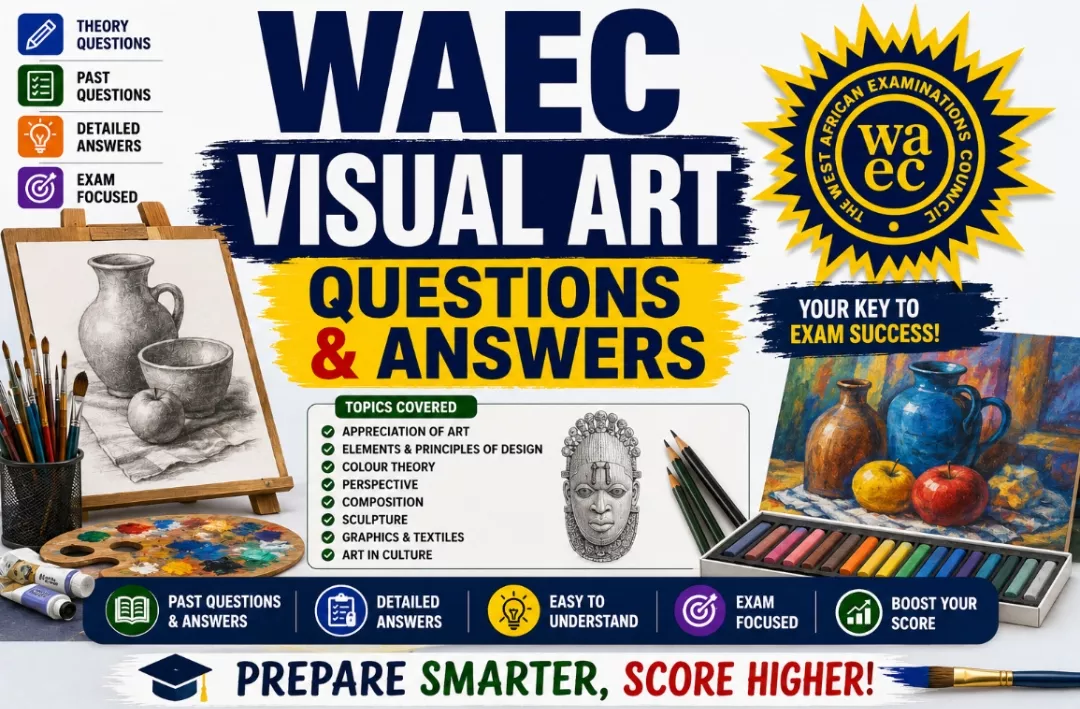
The West African Examination Council (WAEC) has scheduled the WAEC Visual Art 2026 Questions And Answers paper to kick of on 29th May, 2026.
This brings the attention of candidates writing the exam in to searching for WAEC Visual Art 2026 Questions And Answers, WAEC Visual Art Expo 2026, WAEC Visual Art Question And Answer 2026, 2026 WAEC Visual Art Questions And Answers etc.
How to Get WAEC Visual Art 2026 Questions And Answers
In this section, you will read the steps and requirements needed for you to get WAEC Visual Art 2026 Questions And Answers before exam.
WAEC Visual Art 2026 Paper is Categorized in to 2 parts:
- WAEC Visual Art Essay 2026
- WAEC Visual Art Objective 2026
Here on zamgist, we have solved all the questions. (i.e is WAEC Visual Art Essay and Objective 2026).
| 2026 WAEC EXPO | WASSCE Visual Art 2026 |
|---|---|
| N1000 MTN CARD | |
| Online Password | N1000 MTN CARD |
| Direct SMS | |
| Delivery Time | 4 hours or midnight before exam |
| Answer page | https://zamgist.net/ |
| WhatsApp No. | +2349017746445 |
| Source | ZAMGIST |
| Group | ZAMGIST MIRACLE CENTER |
| WhatsApp Group Link | Click Here to Join |
| Tags | Visual Art 2026 Questions And Answers |
WAEC Visual Art Expo 2026
==> WhatsApp: N1000 MTN CARD
Whatsapp MEANS The answer will be sent to you on WhatsApp after we confirm your subscription. Add Us In WhatsApp With +2349017746445.
==> Online PIN: N1000 MTN CARD
Online PIN MEANS The Pin to access our answers online via https://zamgist.net will be sent to u at least 4 hours before the exam to access our answers.
Send The Following details:-
(i) MTN CARD Pin(s)
(ii) Your Name
(iii) Subject
(iv) Phone number
===> 09017746445 via WhatsApp or SMS
RELATED:
- WAEC Timetable 2026 for Science, Art And Commercial
- WAEC Islamic Studies 2026 Questions And Answers (IRS)
- WAEC CRS 2026 Questions And Answers
- WAEC Physics 2026 Questions And Answers
- WAEC Marketing 2026 Questions And Answers
- 2026 WAEC Biology Practical Questions And Answers
- 2026 WAEC Economics Questions And Answers
- WAEC Accounting 2026 Questions And Answers
- 2026 WAEC Commerce Questions And Answers
- WAEC Civic Education 2026 Questions And Answers
- WAEC Expo 2026 | WAEC Questions And Answers 2026
- Ceebook Timetable for WAEC 2026
- Area Of Concentration For Biology WAEC 2026
NOTE:- All SMS sent to the above number are attended to. always send us WhatsApp message of your complaint, your message(s) will get to us and we will reply immediately.
WAEC Visual Art Areas of Concentration 2026
- General Knowledge in Art
- Nature and branches of Art and careers in art
- Visual awareness, understanding and appreciation of Art elements (line, colour, space, shape, form, texture, etc.)
- Principles of Art – balance, rhythm, proportion, harmony, emphasis, variety, etc.
- Perspective – aerial, linear (angular/parallel) and foreshortening
- Production, use and care of art/craft tools and materials (brush, pencil, colour, palette, easels, etc.)
- Art and craft terms – tie and dye, biscuit ware, silhouette, relief, chiaroscuro, sfumato, aperture, etc.
- Inter-relationships of the arts – music, visual art, dance, drama and literary arts
- Art of West Africa
- Traditional Art of West Africa – animism, fetishism and mythology
- Ancient Traditional Art by country:
- Cameroon – Bamileke
- Dahomey (Benin Republic) – Fon
- Gambia – Wollof, Mandinka, Jola
- Ghana – Ashanti, Fante, Ewe, Frafra
- Guinea – Kissi
- Cote d’Ivoire – Senufo, Baule
- Liberia – Dan and Ngere
- Mali – Dogon, Bambara
- Sierra Leone – Mende, Sherbro
- Burkina Faso – Mossi, Bobo, Kurumba
- Nigeria – Benin, Ife, Nok, Igbo-Ukwu, Esie, Owo, etc.
- Modern Traditional Art – Oshogbo art, Ashanti and Ewe Kente, Modern Benin art, Winneba pottery, Abuja pottery, Ntoso adinkra, Bida brass works, calabash carving, Mbari mud sculpture, weaving, leatherwork
- Contemporary Art – art institutions, art schools, galleries, museums, cultural organisations
- Outstanding contemporary West African Artists – training, style, achievements and contributions
- Pre-historic, Ancient Egyptian and Western Art
- Pre-historic Art (20,000 – 2000 BC) – Paleolithic, Mesolithic and Neolithic stone Ages; beliefs, materials, characteristics and functions
- Ancient Egyptian Art (11,000 – 7,000 BC) – Old, Middle and New Kingdoms; beliefs, styles and functions
- Greek Art – Archaic, Classical and Hellenistic periods; characteristics and artists
- Medieval Art – features, media and characteristics
- Renaissance Art – Early, Low and High Renaissance; artists include Giotto, Donatello, Masaccio
- 19th Century Art:
- Impressionism – Paul Cezanne, Claude Monet, Edouard Manet, Georges Seurat
- Post-Impressionism – Vincent van Gogh, Paul Gauguin
- 20th Century Art – Cubism; influence of African Art; artists: Pablo Picasso, George Braque
- Paper 3A – Drawing
- Drawing from Objects – group of man-made/arranged objects
- Drawing from Nature – natural objects, plants, rocks, bones, insects, birds, shells, fish, etc.
- Drawing from Life – structure and form of a living human figure
- Paper 3B – Creative Design (2-Dimensional)
- Graphic Design:
- Lettering and Poster Design – Roman, Gothic characters; posters, greeting cards, logos, emblems, symbols
- Book Illustration – story and text illustrations in books, magazines and newspapers
- Printmaking – linocut, woodcut, yam print, stenciling, screen printing
- Package Design – wrappers, cereal packages, CD jackets
- Computer Graphics – CorelDraw, Adobe Photoshop, etc.
- Textile Design:
- Batik, tie and dye, block or screen printing
- Appliqué – shaped fabric pieces sewn on a foundation fabric
- Tapestry – woven pattern or picture fabric used as wall hanging or upholstery
- Picture-Making:
- Painting – illustrative composition using suitable medium; includes Mural
- Photography – portraits, landscape, seascape, nature, pets; experimental photography
- Mosaic – pictures made with small pieces of coloured glass, paper or tile
- Collage – pictures made from irregular shaped materials like cloth and paper
- Graphic Design:
- Paper 3C – Creative Design (3-Dimensional)
- Sculpture – clay, metal, wood, papier-mâché, cement (clay works must be fired)
- Product Design/Modelling – industrial product models such as automobiles, phones, bottles, cosmetics
- Ceramics – jugs, flower vases, bowls, toy animals/figures (clay works must be fired)
- Crafts:
- Basketry – mats, chairs, hats, stools, bags woven in cane or raffia
- Jewellery – ornaments using metals, beads, plastic, shells, seeds
- Calabash Decoration – designing and decorating calabash using various methods

 Zamgist