 Zamgist
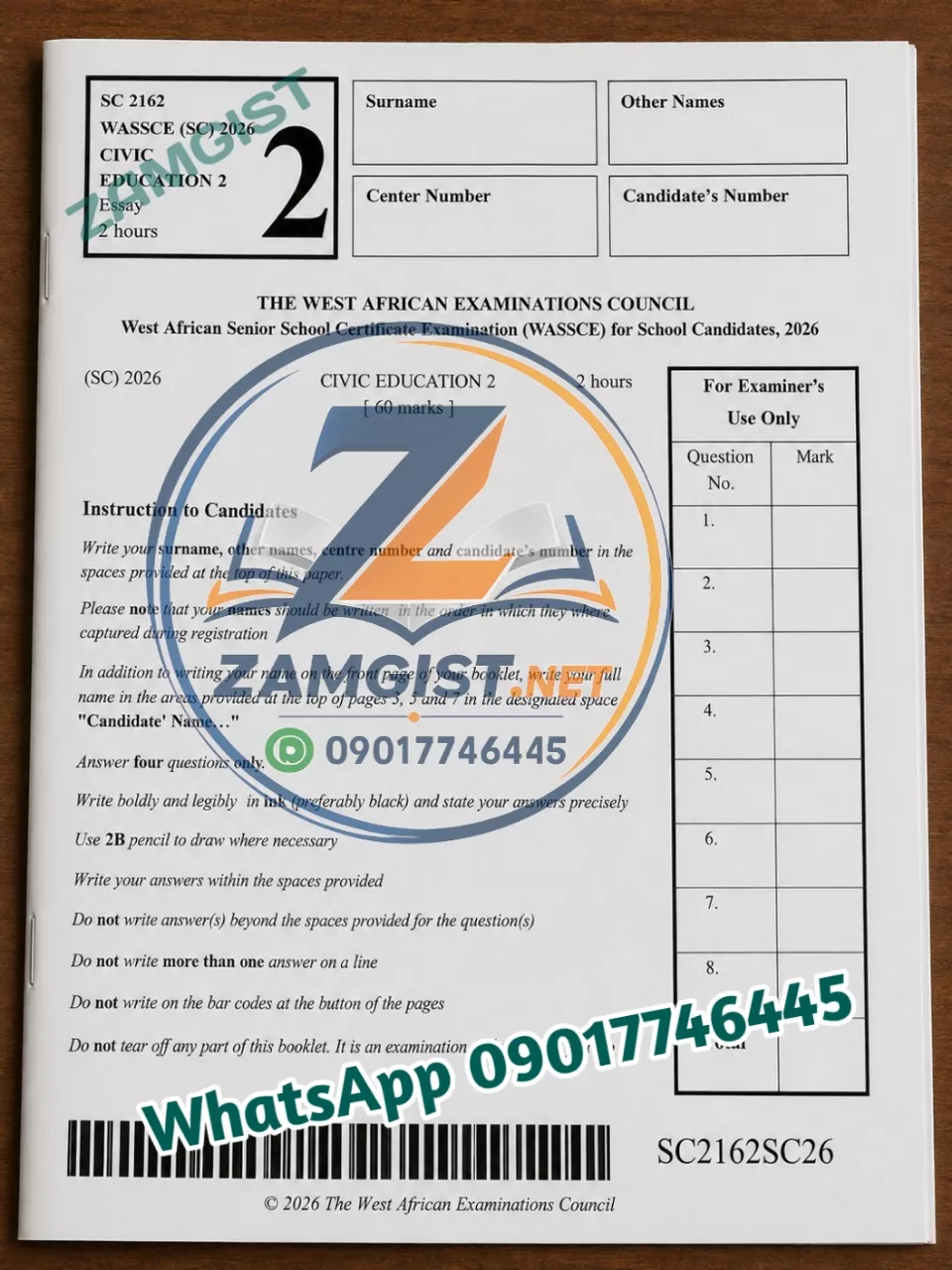
The West African Examination Council (WAEC) Has Scheduled The WAEC Civic Education 2026 Questions And Answers Paper To Kick Of On The 2nd June, 2026.
This brings the attention of candidates writing the exam in to searching for WAEC Civic Education 2026 Questions And Answers, WAEC civic education Expo 2026, WAEC civic education question and answer 2026, 2026 WAEC Civic Education Questions and Answers and etc.
WAEC Civic Education 2026 Questions And Answers
CIVIC EDUCATION OBJ
01-10: CBCBDABBCD
11-20: AACDDBDAAC
21-30: AABACACDBC
31-40: ADBBAABCDC
41-50: BCCDCCBBDD
COMPLETED
(1a)
Honesty is the quality of being truthful, sincere, and trustworthy in one’s words, actions, and dealings with others. It involves telling the truth, keeping promises, avoiding deceit, and acting with integrity at all times.
(1b)
(PICK SIX ONLY)
(i) Loss of Trust: When a person is dishonest, people gradually lose confidence in him or her. Once trust is broken, it becomes very difficult to regain it, and others may become reluctant to depend on the individual.
(ii) Damage to Reputation: Dishonesty can tarnish a person’s good name and image in society. Friends, family members, colleagues, and community members may develop a negative opinion of the individual.
(iii) Broken Relationships: Dishonest behaviour often creates conflicts and misunderstandings among friends, family members, and associates. This may lead to separation, resentment, and loss of valuable relationships.
(iv) Loss of Opportunities: Employers, teachers, and business partners prefer trustworthy individuals. A dishonest person may lose educational, employment, leadership, or business opportunities because of a lack of credibility.
(v) Legal Consequences: Certain dishonest acts such as fraud, forgery, theft, and false testimony may result in arrest, prosecution, fines, or imprisonment under the law.
(vi) Feelings of Guilt and Shame: Dishonesty often causes inner discomfort and emotional distress. The individual may experience guilt, regret, anxiety, and shame for engaging in wrongful actions.
(vii) Poor Moral Character: Repeated dishonest behaviour weakens a person’s moral values and integrity. Over time, the individual may find it easier to engage in more serious unethical activities.
(viii) Loss of Self-Respect: A dishonest person may begin to feel disappointed in himself or herself. This can reduce self-esteem and make the individual feel unworthy of respect and admiration.
(ix) Lack of Peace of Mind: Maintaining lies and deceptive actions often creates fear of being exposed. This constant worry can result in stress, tension, and emotional instability.
(x) Reduced Social Acceptance: Society generally values honesty and integrity. Individuals known for dishonesty may be avoided, rejected, or excluded from important social activities and positions of responsibility.
(2a)
(PICK FIVE ONLY)
(i) National Flag
(ii) National Anthem
(iii) National Pledge
(iv) Coat of Arms
(v) National Currency
(vi) National Constitution
(vii) National Identity Card
(viii) The President’s Seal
(2b)
(PICK FIVE ONLY)
(i) Promotes Peace and Stability: Unity and integration help to reduce ethnic, religious, and regional conflicts, thereby creating a peaceful environment necessary for growth and development.
(ii) Encourages National Loyalty: When citizens are united, they develop a stronger sense of belonging and commitment to the nation, which enhances patriotism and national consciousness.
(iii) Facilitates Economic Growth: A united society attracts local and foreign investors because peace and cooperation create a favourable environment for business activities and economic expansion.
(iv) Enhances Political Stability: Unity among citizens promotes cooperation with government policies and reduces political tension, thereby ensuring a stable political system.
(v) Promotes Effective Utilisation of Resources: National integration encourages people from different parts of the country to work together in the effective management and use of available human and natural resources.
(vi) Encourages Social Development: Unity fosters cooperation among citizens in areas such as education, healthcare, housing, and community development, leading to improved living standards.
(vii) Strengthens National Security: A united population is better able to cooperate with security agencies in protecting the country against internal and external threats.
(viii) Reduces Discrimination and Prejudice: National integration promotes mutual understanding and respect among different ethnic, cultural, and religious groups, thereby reducing hatred and bias.
(ix) Encourages Collective Problem-Solving: Citizens who are united can jointly address national challenges such as poverty, unemployment, insecurity, and environmental problems more effectively.
(x) Enhances International Reputation: A country that enjoys unity and integration is often respected by other nations and is better positioned to attract international partnerships, investments, and development opportunities.
*WAEC CIVIC EDUCATION*
*NUMBER THREE*
(3a)
Universality of human rights refers to the principle that all human beings are entitled to the same fundamental rights and freedoms regardless of their race, colour, sex, religion, nationality, language, social status, or any other difference.
(3b)
(i) Civil Rights: These are rights that protect the personal freedom and liberty of individuals and safeguard them from unfair treatment by others or the government. They enable people to enjoy their lives without interference and ensure respect for human dignity. For example, a citizen who is unlawfully arrested has the right to challenge the detention in court and demand freedom from arbitrary arrest.
(ii) Political Rights: These are rights that allow individuals to participate actively in the political affairs and governance of their country. They enable citizens to influence government decisions and leadership selection. For example, an adult citizen who casts a vote during a general election or contests for a public office is exercising his or her political rights.
(iii) Economic Rights: These are rights that guarantee individuals access to economic opportunities and resources necessary for a decent standard of living. They ensure that people can earn a livelihood and enjoy fair conditions of work. For example, a worker who receives fair wages for services rendered and works in a safe environment is enjoying economic rights.
(iv) Social and Cultural Rights: These are rights that promote the social welfare, cultural identity, education, and overall well-being of individuals within society. They help people develop their talents and participate fully in their cultural heritage. For example, a child attending school to receive education and members of a community practising and preserving their traditional language and cultural festivals are exercising their social and cultural rights.
*WAEC CIVIC EDUCATION*
*NUMBER FOUR*
(4a)
Youth empowerment is the process of equipping young people with the knowledge, skills, resources, opportunities, and confidence needed to enable them participate effectively in social, economic, and political activities.
(4b)
(PICK SIX ONLY)
(i) Inadequate Funding: Many youth empowerment programmes fail to achieve their objectives because sufficient financial resources are not provided for training, equipment, facilities, and other essential activities required for successful implementation.
(ii) Corruption and Mismanagement: The diversion or misuse of funds meant for youth development programmes often prevents the intended beneficiaries from receiving the support and opportunities designed for them.
(iii) Poor Planning and Implementation: When empowerment programmes are not properly planned, coordinated, and monitored, they may fail to address the actual needs of young people, resulting in poor outcomes.
(iv) Lack of Awareness: Many youths are unaware of available empowerment opportunities due to inadequate publicity and dissemination of information, thereby limiting participation and effectiveness.
(v) Inadequate Training Facilities: The absence of modern equipment, workshops, training centres, and learning materials can hinder the acquisition of practical skills needed for self-employment and career development.
(vi) High Level of Unemployment: Widespread unemployment discourages many youths from participating actively in empowerment programmes because they may lose confidence in the possibility of gaining meaningful employment after training.
(vii) Poor Educational Background: Some youths lack the basic educational qualifications and literacy skills required to benefit fully from empowerment programmes, reducing their chances of success.
(viii) Political Interference: Youth empowerment programmes are sometimes influenced by political interests, favouritism, and nepotism, leading to the exclusion of deserving beneficiaries and the failure of programme objectives.
(ix) Negative Attitudes Among Youths: Lack of commitment, indiscipline, laziness, unwillingness to learn, and poor work ethics among some participants can undermine the effectiveness of empowerment initiatives.
(x) Inadequate Access to Credit and Start-Up Capital: After acquiring vocational and entrepreneurial skills, many youths are unable to establish businesses because they lack access to loans, grants, or financial support needed to start and sustain their ventures.
(6a)
(PICK FIVE ONLY)
(i) Disruption of Academic Activities: Cult-related activities often create fear and insecurity within the school, leading to interruptions in lectures, examinations, and other academic programmes, thereby affecting students’ learning.
(ii) Increase in Violence and Crime: Cult groups are frequently associated with violent clashes, assaults, intimidation, and other criminal acts that threaten the safety of students, staff, and property.
(iii) Loss of Lives: Rival cult confrontations and violent attacks can result in injuries and deaths of students, teachers, and innocent members of the school community.
(iv) Destruction of School Property: Cult members may engage in vandalism during conflicts, causing damage to classrooms, laboratories, hostels, libraries, vehicles, and other school facilities.
(v) Decline in Academic Performance: Students involved in cult activities often devote less time to their studies, resulting in poor academic achievement and failure in examinations.
(vi) Creation of Fear and Insecurity: The presence of cult groups creates an atmosphere of fear among students and staff, making it difficult for them to concentrate on teaching and learning activities.
(vii) Increase in Student Dropout Rate: Some students may withdraw from school due to threats, harassment, or fear of becoming victims of cult violence, thereby affecting their educational pursuits.
(viii) Damage to the Institution’s Reputation: Schools known for cult-related activities may develop a negative public image, which can reduce public confidence and discourage prospective students from seeking admission.
(ix) Promotion of Indiscipline and Moral Decadence: Cultism encourages behaviours such as drug abuse, bullying, intimidation, extortion, and other forms of misconduct that undermine discipline and moral values.
(x) Psychological and Emotional Trauma: Victims and witnesses of cult violence may suffer fear, anxiety, stress, depression, and other emotional problems that can affect their well-being and academic progress.
(6b)
(PICK FIVE ONLY)
(i) Enactment of Anti-Cultism Laws: The government has enacted laws that prohibit cultism and prescribe severe penalties for individuals found guilty of participating in cult-related activities, thereby serving as a deterrent to potential offenders.
(ii) Strengthening Security on Campuses: Government authorities have provided security personnel and collaborated with law enforcement agencies to monitor educational institutions and maintain law and order within school environments.
(iii) Public Enlightenment Campaigns: The government organizes awareness programmes, seminars, workshops, and media campaigns to educate students on the dangers and consequences of cultism.
(iv) Expulsion of Cult Members: Educational authorities, with government support, expel students found to be involved in cult activities in order to discourage others from joining such groups.
(v) Prosecution of Offenders: Students and other individuals arrested for cult-related offences are investigated and prosecuted according to the law, helping to reduce the spread of cultism.
(vi) Establishment of Guidance and Counselling Services: The government encourages schools to provide guidance and counselling units that help students make positive decisions and avoid involvement in cult groups.
(vii) Promotion of Moral and Civic Education: Educational policies support the teaching of moral values, civic responsibility, and good character to help students develop positive attitudes and behaviours.
(viii) Encouragement of Student Associations and Clubs: The government promotes legitimate social, cultural, academic, and sporting clubs that provide students with constructive avenues for interaction and self-development.
(ix) Collaboration with Parents and Community Leaders: Government agencies work with parents, religious leaders, traditional rulers, and community organizations to identify and prevent cult-related activities among youths.
(x) Provision of Youth Empowerment and Recreational Programmes: The government supports programmes that engage students in productive activities such as sports, vocational training, leadership development, and entrepreneurship, thereby reducing the attraction of cult groups.
(7a)
Judicial independence is the principle whereby judges and courts are free to perform their duties and make decisions according to the law and facts before them without interference, pressure, influence, or control from the executive, legislature, political groups, or private individuals.
(7b)
(PICK SIX ONLY)
(i) Constitutional Guarantee of Judicial Independence: The constitution should clearly provide for the independence of the judiciary and protect judges from undue interference by other arms of government. Such constitutional provisions help to safeguard the judiciary’s authority and autonomy.
(ii) Security of Tenure for Judges: Judges should enjoy secure tenure and should not be removed from office arbitrarily. They should only be removed through established legal procedures based on proven misconduct or incapacity, thereby enabling them to perform their duties without fear.
(iii) Financial Autonomy of the Judiciary: The judiciary should have access to adequate funds and control over its budget without unnecessary dependence on the executive arm of government. Financial independence reduces external influence on judicial decisions.
(iv) Merit-Based Appointment of Judges: Judges should be appointed based on competence, integrity, experience, and professional qualifications rather than political affiliation, nepotism, or personal connections. This promotes impartiality and public confidence in the judicial system.
(v) Adequate Remuneration and Welfare Packages: Judges should receive good salaries, allowances, pensions, and other benefits that reflect the importance of their office. Proper remuneration reduces susceptibility to corruption and external influence.
(vi) Protection from Political Interference: Political office holders and government officials should not interfere in court proceedings or attempt to influence judicial decisions. The judiciary must be allowed to operate independently in accordance with the law.
(vii) Separation of Powers: The principle of separation of powers should be strictly observed so that the judiciary functions independently from the executive and legislative branches. This prevents excessive concentration of power and promotes checks and balances.
(viii) Freedom from Intimidation and Threats: Judges should be protected from harassment, threats, violence, and undue pressure from individuals, groups, or government agencies. Adequate security measures should be provided to guarantee their safety.
(ix) Establishment of Independent Judicial Bodies: Institutions such as judicial councils and service commissions should oversee the appointment, promotion, discipline, and welfare of judges without interference from political authorities. This strengthens professionalism and accountability within the judiciary.
(x) Respect for Court Judgments and Rule of Law: Government officials, organizations, and citizens should obey court decisions and uphold the rule of law. Respect for judicial pronouncements enhances the authority, credibility, and independence of the judiciary in a democratic state.
(8a)
(PICK FIVE ONLY)
(i) Large Population Size: Nigeria has a very large population, making it difficult for all citizens to participate directly in the making of government decisions. Representative democracy allows citizens to elect individuals who will make decisions on their behalf.
(ii) Vast Geographical Area: Nigeria covers a large geographical territory with many states and local government areas. Representative democracy makes governance easier by allowing elected representatives to speak for people from different parts of the country.
(iii) Diversity of Ethnic Groups: Nigeria is made up of numerous ethnic groups with different cultures, languages, and traditions. Representative democracy ensures that these diverse groups have the opportunity to be represented in government.
(iv) Promotion of Political Participation: Representative democracy provides citizens with the opportunity to participate in governance through the election of leaders who represent their interests and aspirations.
(v) Efficient Decision-Making: It is more practical and effective for elected representatives to deliberate and make decisions on behalf of the people than for the entire population to be directly involved in every governmental matter.
(vi) Protection of Minority Interests: Through elected representatives, minority groups can have their views and concerns presented in government, thereby preventing domination by the majority.
(vii) Encouragement of Accountability: Elected representatives are expected to explain their actions and decisions to the people who elected them. This promotes responsible leadership and good governance.
(viii) Reduction of Administrative Difficulties: Direct democracy would be difficult to operate in a country as large and complex as Nigeria. Representative democracy simplifies the process of administration and governance.
(ix) Promotion of National Unity and Integration: By allowing people from different regions, religions, and ethnic backgrounds to participate in governance through representation, representative democracy fosters national cohesion and peaceful coexistence.
(x) Compliance with Modern Democratic Practices: Most modern nations operate representative democracy because it is suitable for large populations and complex societies. Nigeria adopted this system to ensure effective governance, political stability, and democratic development.
(8b)
(PICK FIVE ONLY)
(i) Electoral Malpractices: Electoral fraud such as ballot box snatching, vote buying, voter intimidation, falsification of election results, and multiple voting undermines the credibility of elections and weakens democratic governance. When citizens lose confidence in the electoral process, democratic development is hindered.
(ii) Corruption: Corruption among public officials and political leaders leads to the mismanagement and diversion of public resources meant for national development. It reduces public trust in government institutions and weakens democratic principles of accountability and transparency.
(iii) Political Violence: Violence during elections and political activities often results in injuries, loss of lives, destruction of property, and voter apathy. Such acts discourage citizens from participating actively in the democratic process.
(iv) Poverty: Many citizens living in poverty may become vulnerable to political manipulation, vote buying, and other forms of exploitation by politicians. This limits their ability to make independent political choices and weakens democratic participation.
(v) Illiteracy: A high level of illiteracy prevents many citizens from understanding their political rights, government policies, and electoral processes. As a result, they may be easily misled or manipulated by political actors.
(vi) Weak Democratic Institutions: Institutions such as the electoral commission, judiciary, legislature, political parties, and law enforcement agencies may be ineffective due to inadequate resources, lack of independence, or poor administration. Weak institutions reduce the effectiveness of democratic governance.
(vii) Ethnic and Religious Politics: Political leaders sometimes exploit ethnic and religious differences for personal or political gain. This practice promotes division, intolerance, and conflict, thereby obstructing democratic growth and national unity.
(viii) Lack of Internal Democracy in Political Parties: Many political parties fail to conduct transparent primaries and democratic decision-making processes. Imposition of candidates and favouritism often discourage qualified individuals from participating in politics.
(ix) Insecurity: Problems such as terrorism, banditry, kidnapping, armed robbery, and communal conflicts create fear and instability. Insecure environments make it difficult to conduct free and fair elections and weaken democratic institutions.
(x) Political Apathy: Some citizens show little interest in political activities due to disappointment, distrust of leaders, or a belief that their votes do not matter. Low political participation reduces public involvement in governance and slows democratic development.
(9a)
(PICK THREE ONLY)
(i) Corruption
(ii) Abuse of Power
(iii) Lack of Accountability
(iv) Selfishness and Personal Interest
(v) Incompetence and Poor Leadership Skills
(vi) Political Bias and Favouritism
(vii) Lack of Transparency in Governance
(9b)
(PICK SIX ONLY)
(i) Provision of Basic Amenities: Leaders should ensure the provision of essential social amenities such as good roads, electricity, clean water, healthcare facilities, and educational institutions. These services improve the quality of life of the people and promote social development.
(ii) Ensuring Security of Lives and Property: Leaders should establish effective security measures to protect citizens from crime, violence, terrorism, and other threats. A secure environment enables people to live and work peacefully.
(iii) Promoting Equal Opportunities: Leaders should ensure that all citizens have equal access to employment, education, political participation, and other opportunities regardless of ethnicity, religion, gender, or social status.
(iv) Protecting Fundamental Human Rights: Leaders should uphold and defend the rights and freedoms of citizens, including freedom of speech, freedom of association, freedom of religion, and protection from discrimination and injustice.
(v) Creating Employment Opportunities: Leaders should formulate policies and programmes that encourage job creation, entrepreneurship, and economic growth in order to reduce unemployment and improve living standards.
(vi) Ensuring Justice and Fairness: Leaders should promote the rule of law and ensure that justice is administered impartially. Citizens should be treated fairly without favouritism, bias, or discrimination.
(vii) Maintaining Transparency and Accountability: Leaders should manage public resources honestly and provide regular accounts of their actions and decisions. This helps to build trust and confidence among the people.
(viii) Consulting the People Before Making Decisions: Effective leaders seek the opinions, needs, and aspirations of their followers before implementing policies. This ensures that government actions reflect the interests of the people.
(ix) Supporting Education and Human Development: Leaders should invest in quality education, vocational training, healthcare services, and youth empowerment programmes to enhance the knowledge, skills, and well-being of citizens.
(x) Responding Promptly to Public Needs and Complaints: Leaders should establish mechanisms for receiving and addressing the concerns of citizens. Prompt attention to public grievances strengthens trust, promotes good governance, and ensures that the interests of the people are adequately protected.
WAEC Civic Education Essay Questions 2026
INSTRUCTION: Answer four questions in all, choosing at least one question from each section. All questions carry equal marks.
SECTION A: National Ethics, Discipline, Rights and Obligations
Answer at least one question from this section.
Question 1.
(a) Explain honesty.
(b) State six consequences of dishonesty on individuals.
Question 2.
(a) Mention five national symbols.
(b) State five reasons the promotion of unity and integration is an imperative condition for national development.
Question 3.
(a) Explain human trafficking.
(b) With specific examples, explain the four categories of human rights.
SECTION B: Emerging Issues in the Society
Answer at least one question from this section.
Question 4.
(a) Explain youth empowerment.
(b) Explain six factors that constitute hindrance to achieving the objectives of youth empowerment programmes.
Question 5.
Explain five reasons victims of human trafficking do not seek help.
Question 6.
(a) Enumerate five effects of cult-related activities within the school environment.
(b) Explain five efforts of government in taming cultism in the Nigerian educational system.
SECTION C: Governmental System and Processes
Answer at least one question from this section.
Question 7.
(a) Explain judicial independence.
(b) Highlight six ways of ensuring judicial independence in a democratic state.
Question 8.
(a) Identify five reasons for the adoption of representative democracy in Nigeria.
(b) Explain five factors that retard the growth of democracy in Nigeria.
Question 9.
(a) Mention three reasons leaders failed to protect the interests of their followers.
(b) Explain six ways leaders can take care of the interests of their followers.
How to Get WAEC Civic Education 2026 Questions And Answers
In this section, you will read the steps and requirements needed for you to get WAEC Civic Education 2026 Questions And Answers before exam.
CLICK HERE TO CHAT ME UP ON WHATSAPP TO PAY ₦1000 AND GET IT NOW
WAEC Civic Education 2026 Paper is Categorized in to 2 parts:
- WAEC Civic Education Essay 2026
- WAEC Civic Education Objective 2026
Here on zamgist, we have solved all the questions. (i.e is WAEC Civic Education Essay and Objective 2026).
| 2026 WAEC EXPO | WASSCE CIVIC EDUCATION 2026 |
|---|---|
| N1000 MTN CARD | |
| Online Password | N1000 MTN CARD |
| Direct SMS | |
| Delivery Time | 4 hours or midnight before exam |
| Answer page | https://zamgist.net |
| WhatsApp No. | +2349017746445 |
| Source | ZAMGIST |
| Group | ZAMGIST MIRACLE CENTER |
| WhatsApp Group Link | Click Here to Join |
| Tags | Civic Education 2026 Questions And Answers |
WAEC Civic Education Expo 2026
==> WhatsApp ₦1000 MTN CARD
Whatsapp MEANS The answer will be sent to you on WhatsApp after we confirm your subscription. Add Us In WhatsApp With +2349017746445.
==> Online PIN: N800 MTN CARD
Online PIN MEANS The Pin to access our answers online @ https://zamgist.net will be sent to u at least 4 hours before the exam to access our answers.
Send The Following details:-
(i) MTN CARD Pin(s)
(ii) Your Name
(iii) Subject
(iv) Phone number
===> 09017746445 via WhatsApp or SMS
RELATED:
- WAEC Timetable 2026 for Science, Art And Commercial
- WAEC Civic Education 2026 Questions And Answers
- WAEC Catering Craft Practice 2026 Questions And Answers
- WAEC Commerce 2026 Questions And Answers
- WAEC Accounting 2026 Questions And Answers
- WAEC Expo 2026 | WAEC Questions And Answers 2026
NOTE:- All SMS sent to the above number are attended to. always send us WhatsApp message of your complaint, your message(s) will get to us and we will reply immediately.


 Zamgist