 Zamgist
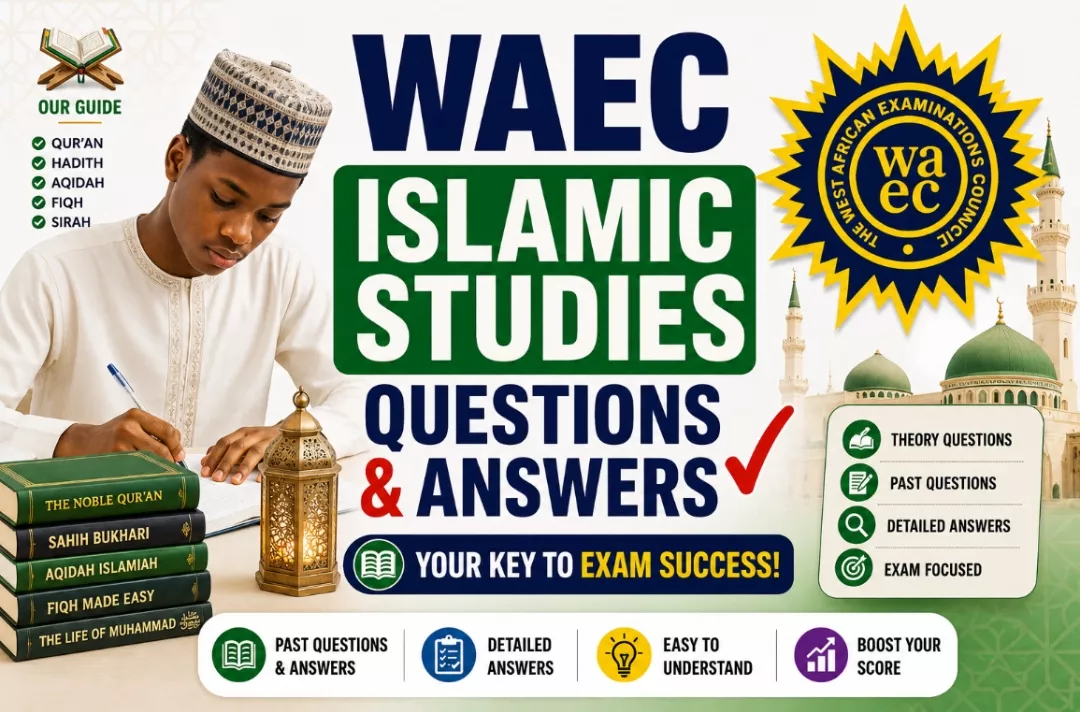
The West African Examination Council (WAEC) has scheduled the WAEC Islamic Studies 2026 Questions And Answers paper to kick of on 1st June, 2026.
This brings the attention of candidates writing the exam in to searching for WAEC Islamic Studies 2026 Questions And Answers, WAEC Islamic Studies Expo 2026, WAEC Islamic Studies Question And Answer 2026, 2026 WAEC Islamic Studies Questions And Answers etc.
How to Get WAEC Islamic Studies 2026 Questions And Answers
In this section, you will read the steps and requirements needed for you to get WAEC Islamic Studies 2026 Questions And Answers before exam.
WAEC Islamic Studies 2026 Paper is Categorized in to 2 parts:
- WAEC Islamic Studies Essay 2026
- WAEC Islamic Studies Objective 2026
Here on zamgist, we have solved all the questions. (i.e is WAEC Islamic Studies Essay and Objective 2026).
| 2026 WAEC EXPO | WASSCE Islamic Studies 2026 |
|---|---|
| N1000 MTN CARD | |
| Online Password | N1000 MTN CARD |
| Direct SMS | |
| Delivery Time | 4 hours or midnight before exam |
| Answer page | https://zamgist.net |
| WhatsApp No. | +2349017746445 |
| Source | ZAMGIST |
| Group | ZAMGIST MIRACLE CENTER |
| WhatsApp Group Link | Click Here to Join |
| Tags | Islamic Studies 2026 Questions And Answers |
WAEC Islamic Studies Expo 2026
==> WhatsApp N1000 MTN CARD
Whatsapp MEANS The answer will be sent to you on WhatsApp after we confirm your subscription. Add Us In WhatsApp With +2349017746445.
==> Online PIN: N1000 MTN CARD
Online PIN MEANS The Pin to access our answers online via https://zamgist.net will be sent to u at least 4 hours before the exam to access our answers.
Send The Following details:-
(i) MTN CARD Pin(s)
(ii) Your Name
(iii) Subject
(iv) Phone number
===> 09017746445 via WhatsApp or SMS
RELATED:
- WAEC Timetable 2026 for Science, Art And Commercial
- WAEC CRS 2026 Questions And Answers
- WAEC Physics 2026 Questions And Answers
- WAEC Civic Education 2026 Questions And Answers
- WAEC Marketing 2026 Questions And Answers
- 2026 WAEC Biology Practical Questions And Answers
- 2026 WAEC Economics Questions And Answers
- WAEC Accounting 2026 Questions And Answers
- 2026 WAEC Commerce Questions And Answers
- WAEC Civic Education 2026 Questions And Answers
- WAEC Expo 2026 | WAEC Questions And Answers 2026
- Ceebook Timetable for WAEC 2026
- Area Of Concentration For Biology WAEC 2026
NOTE:- All SMS sent to the above number are attended to. always send us WhatsApp message of your complaint, your message(s) will get to us and we will reply.
WAEC IRS 2026 Areas of Concentration
Below are the major topics and likely areas of concentration for the WAEC Islamic Religious Studies (IRS) 2026 examination. Candidates are advised to study all the topics carefully together with relevant Qur’anic verses, Hadith and practical applications.
PART 1: TARIKH (Historical Development of Islam)
- The Jahiliyyah: Arabia Before Islam
- Location and Description of Arabia
- Social Life
- Marriage, Divorce and Inheritance
- Religious Life and Idol Worship
- Political System
- Economic Activities
- Reforms Introduced by Islam
- The Life of Prophet Muhammad (S.A.W.)
- Birth of the Prophet
- Marriage
- Call to Prophethood and Mission
- Hijrah: Causes, Course and Significance
- Formation of the Ummah and Madinan Constitution
- Leadership Qualities of the Prophet
- The Battles of Badr, Uhud and Khandaq
- The Treaty of Hudaybiyyah
- Conquest of Makkah
- The Farewell Pilgrimage
- Death of the Prophet
- The Khulafa’ur-Rashidun (Rightly Guided Caliphs)
- Abu Bakr
- Umar Ibn al-Khattab
- Uthman Ibn Affan
- Ali Ibn Abi Talib
- Their Contributions to Islam
- Lessons from Their Lives
- Islam in West Africa
- Spread of Islam Through Traders and Scholars
- Roles of Sufi Orders and Reformers
- Impact of Islam on West African Empires
- Islam in Ghana, Mali, Songhai and Kanem-Borno
PART 2: QUR’AN
- Revelation of the Qur’an
- First Revelation
- Cave Hira Experience
- Modes of Revelation
- Piecemeal Revelation
- Preservation of the Qur’an
- Recording and Compilation
- Standardization of the Qur’an
- Makki and Madani Suwar
- Roles of the Companions
- Importance of the Qur’an
- Guidance in Spiritual and Moral Life
- Political and Social Importance
- Study of Selected Surahs
- Suratul Fatihah
- Suratud Duha
- Suratut Tin
- Suratul Alaq
- Suratul Qadr
- Suratul Kafirun
- Suratun Nasr
- Suratul Ikhlas
- Suratul Falaq
- Suratun Nas
- Moral Lessons from the Qur’an
- Attitude to Parents
- Honesty in Words and Deeds
- Prohibition of Gambling
PART 3: HADITH
- Definition of Hadith and Sunnah
- Differences and Similarities Between Hadith and Sunnah
- Importance of Hadith and Sunnah
- Parts of Hadith
- Isnad
- Matn
- Rawi
- Criteria for Authenticity of Hadith
- Classification of Hadith
- Sahih
- Hasan
- Da’if
- The Six Sound Collections of Hadith (Sihahus-Sittah)
- Study of Selected Hadith from An-Nawawi Collection
PART 4: TAWHEED AND FIQH
- Iman (Faith)
- Meaning and Significance of Iman
- Belief in Allah
- Belief in Angels
- Belief in Holy Books
- Belief in Prophets
- Belief in the Day of Judgment
- Qada and Qadar
- Shirk (Associating Partners with Allah)
- Idol Worship
- Ancestor and Hero Worship
- Taharah (Purification)
- Importance of Purification
- Istinja
- Wudu
- Tayammum
- Ghusl
- Salat (Prayer)
- Meaning and Importance of Salat
- Acts that Invalidate Salat
- Congregational Prayer
- Sujudus-Sahwi
- Obligatory Prayers
- Voluntary Prayers
- Special Prayers
- Salatul-Safar
- Sawm (Fasting)
- Meaning and Types of Fasting
- Ramadan Fast
- Voluntary Fasting
- People Exempted from Fasting
- Benefits of Fasting
- Zakat (Charity)
- Meaning of Zakat and Sadaqah
- Differences Between Zakat and Sadaqah
- Articles on Which Zakat is Paid
- Nisab of Zakat
- Beneficiaries of Zakat
- Zakatul-Fitr
- Benefits of Zakat
- Hajj and Umrah
- Meaning and Origin
- Conditions for Hajj
- Performance of Hajj and Umrah
- Types of Hajj
- Rites of Hajj
- Significance of Hajj
- Shari’ah
- Meaning of Shari’ah
- Sources of Shari’ah
- Importance of Shari’ah
- Nikah (Marriage)
- Concept of Marriage in Islam
- Prohibited Categories in Marriage
- Conditions for Valid Marriage
- Rights and Duties of Husband and Wife
- Prohibition of Ill-treatment of Wife
- Talaq (Divorce)
- Islamic Attitude to Divorce
- Types of Divorce
- Iddah (Waiting Period)
Note: Candidates are advised to study Qur’anic verses, Hadith references, Arabic terms, meanings, lessons and practical applications for each topic carefully.
WAEC IRS Likely Questions and Answers 2026
Below are some likely WAEC Islamic Religious Studies (IRS) 2026 essay questions and simplified answers based on repeated WAEC syllabus topics and past examination trends.
1. Describe the Religious Life of the Arabs Before Islam
Answer:
Before Islam, the Arabs practiced idol worship and polytheism. They worshipped idols such as Hubal, Lat, Uzza and Manat. Many Arabs believed in superstitions and consulted soothsayers. Although a few people still followed the religion of Prophet Ibrahim, most people practiced paganism. Islam later abolished idol worship and introduced the worship of one God, Allah.
2. Explain the Causes and Significance of the Hijrah
Answer:
The Hijrah refers to the migration of Prophet Muhammad (S.A.W.) and his followers from Makkah to Madinah. The migration happened because Muslims were persecuted by the Quraysh in Makkah. The Hijrah was significant because it marked the beginning of the Islamic calendar, strengthened the Muslim community, and led to the establishment of the first Islamic state in Madinah.
3. State the Leadership Qualities of Prophet Muhammad (S.A.W.)
Answer:
Prophet Muhammad (S.A.W.) was honest, trustworthy, patient, humble and courageous. He treated people fairly and showed kindness to both Muslims and non-Muslims. He was also a wise leader who consulted his companions before making important decisions. Muslims are encouraged to imitate his good character and leadership qualities.
4. Discuss the Contributions of Abu Bakr to Islam
Answer:
Abu Bakr was the first Caliph after the death of Prophet Muhammad (S.A.W.). He fought against apostasy during the Ridda wars and preserved the unity of the Muslim community. He also initiated the compilation of the Qur’an to prevent it from being lost. Abu Bakr remained loyal and dedicated to Islam throughout his life.
5. Explain How the Qur’an Was Preserved
Answer:
The Qur’an was preserved through memorization, writing and compilation. During the lifetime of Prophet Muhammad (S.A.W.), many companions memorized the Qur’an, while scribes wrote the revelations on bones, leather and leaves. During the caliphate of Abu Bakr, the Qur’an was compiled into one book. Uthman later standardized copies and distributed them to different Muslim communities.
6. Mention the Importance of the Qur’an to Muslims
Answer:
The Qur’an serves as a guide for Muslims in spiritual, moral, social and political matters. It teaches Muslims how to worship Allah and live righteous lives. The Qur’an also provides laws and moral teachings that promote justice, honesty and peaceful coexistence in society.
7. Explain the Difference Between Hadith and Sunnah
Answer:
Hadith refers to the recorded sayings, actions and approvals of Prophet Muhammad (S.A.W.), while Sunnah refers to the practices and way of life of the Prophet. Hadith serves as the source through which Sunnah is known. Both Hadith and Sunnah guide Muslims in religious matters.
8. Discuss the Importance of Salat in Islam
Answer:
Salat is one of the five pillars of Islam and is obligatory for every mature Muslim. It strengthens the relationship between Muslims and Allah, promotes discipline and cleanliness, and prevents sinful behavior. Salat also unites Muslims through congregational worship and reminds believers of their duties to Allah.
9. Explain the Spiritual Benefits of Fasting
Answer:
Fasting teaches self-discipline, patience and obedience to Allah. It helps Muslims develop sympathy for the poor and encourages spiritual purification. During Ramadan, Muslims increase acts of worship such as prayer, charity and recitation of the Qur’an. Fasting also helps believers avoid sinful acts.
10. State the Importance of Zakat
Answer:
Zakat helps to reduce poverty and support the needy in society. It purifies the wealth of Muslims and promotes social equality. Through Zakat, wealthy Muslims assist the poor, widows, orphans and travelers. It also strengthens unity and brotherhood among Muslims.
11. Explain the Significance of Hajj
Answer:
Hajj is the pilgrimage to Makkah performed by Muslims who are financially and physically capable. It strengthens faith, promotes unity among Muslims worldwide and reminds believers of equality before Allah. Hajj also encourages patience, sacrifice and obedience to Allah.
12. Discuss the Rights and Duties of Husband and Wife in Islam
Answer:
In Islam, both husband and wife have rights and responsibilities. The husband is expected to provide for and protect the family, while the wife should support and respect her husband. Both must treat each other with kindness, love and fairness. Islam prohibits oppression and ill-treatment within marriage.
13. Explain the Islamic View on Divorce (Talaq)
Answer:
Islam permits divorce as a last resort when peaceful settlement fails. Divorce should be handled fairly and according to Islamic guidelines. Islam discourages unnecessary divorce because it can destroy families and create hardship. After divorce, the woman observes the waiting period known as Iddah.
14. Mention the Articles of Faith in Islam
Answer:
The six articles of faith in Islam are:
- Belief in Allah
- Belief in Angels
- Belief in Holy Books
- Belief in Prophets
- Belief in the Day of Judgment
- Belief in Qada and Qadar
These beliefs form the foundation of Islamic faith and guide Muslims in their daily lives.
15. Explain the Meaning and Importance of Taharah
Answer:
Taharah means purification or cleanliness in Islam. It includes Wudu, Ghusl and Tayammum. Cleanliness is important because it is a condition for valid prayer and promotes good health. Islam encourages Muslims to maintain both physical and spiritual purity at all times.
Examination Tip: Candidates should study Arabic terms, Qur’anic verses, Hadith references, moral lessons and past WAEC IRS questions regularly for better performance in the examination.


 Zamgist