The West African Examinations Council (WAEC) has officially released the WAEC Biology Practical Specimens 2026. Candidates preparing for the Biology Practical examination are advised to study all the specimens carefully and understand their characteristics, functions, economic importance, and biological relationships.
The Biology Practical examination is one of the most important sections of the WAEC Biology paper because it tests candidates’ ability to identify specimens, carry out food tests, make biological drawings, interpret observations, and apply biological principles.
In this guide, we have provided the complete list of WAEC Biology Practical Specimens 2026, explanations of each specimen, likely practical questions, areas of concentration, and preparation tips.
WAEC Biology Practical Specimens 2026
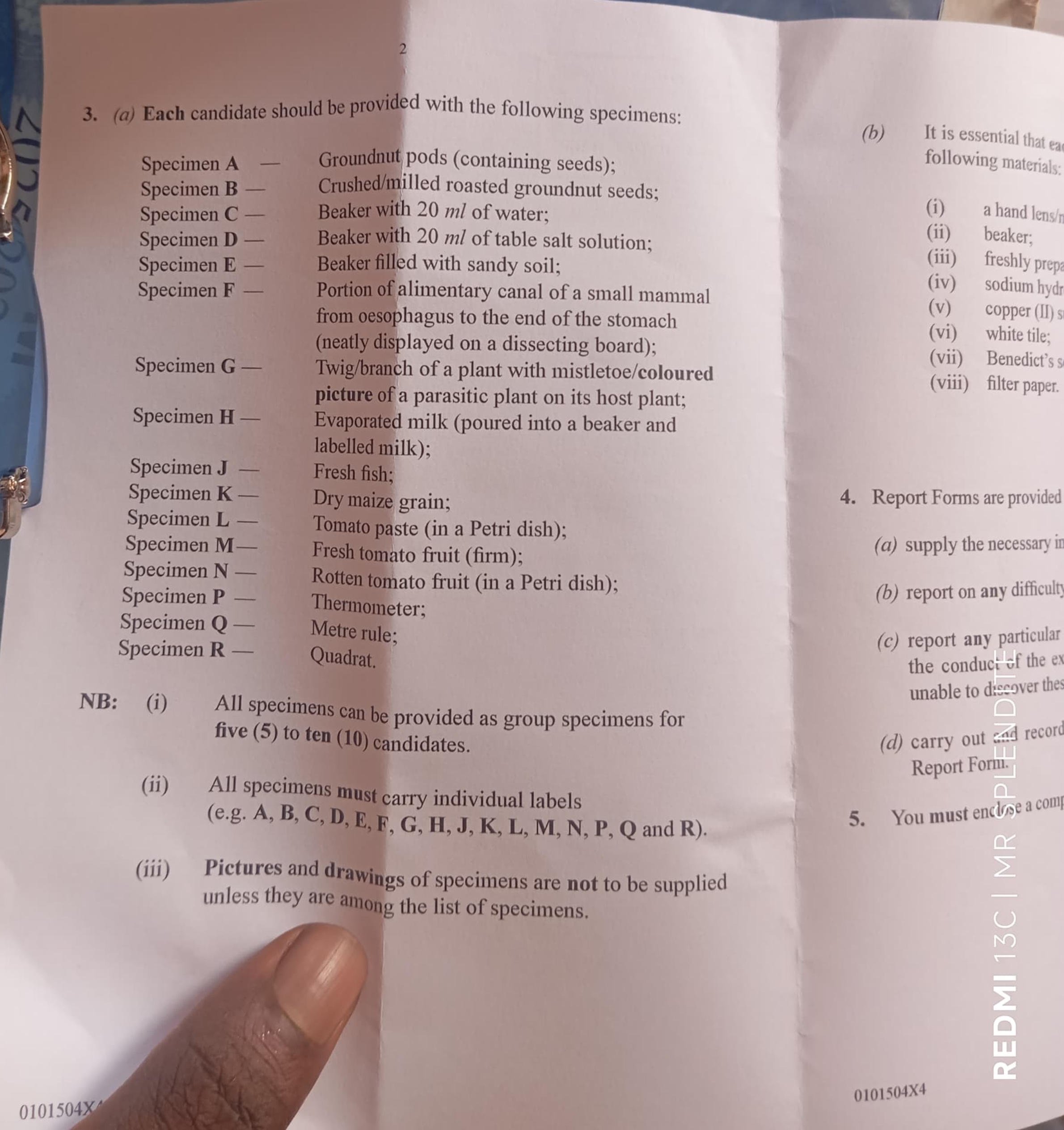
According to the official WAEC Biology Practical Instructions, each candidate should be provided with the following specimens:
| Specimen | Description |
|---|---|
| A | Groundnut Pods (Containing Seeds) |
| B | Ground/Milled Roasted Groundnut Seeds |
| C | Beaker Containing 20ml of Water |
| D | Beaker Containing 20ml of Table Salt Solution |
| E | Beaker Filled With Sandy Soil |
| F | Prepared Oesophagus to End of Stomach of a Small Mammal |
| G | Coloured Picture of a Plant With Mistletoe |
| H | Picture of a Parasitic Plant on Its Host Plant |
| J | Evaporated Milk |
| K | Fresh Fish |
| L | Dry Maize Grain |
| M | Tomato Paste |
| N | Fresh Tomato Fruit |
| P | Rotten Tomato Fruit |
| Q | Thermometer |
| R | Metre Rule |

Additional Materials Required for WAEC Biology Practical 2026
WAEC has also directed that each candidate should be provided with the following laboratory materials:
- Hand lens or magnifying lens
- Beaker
- Freshly prepared iodine solution
- Sodium hydroxide solution
- Copper (II) sulphate solution
- White tile
- Benedict’s solution
- Filter paper
These materials are mainly used for food tests, specimen observations, and practical experiments.
WAEC Biology Practical Specimens 2026 Explained
Specimen A – Groundnut Pods
Groundnut is a leguminous crop belonging to the family Fabaceae.
Features of groundnut pods include:
- Dry fruit
- Contains seeds
- Rich in oil and protein
- Develops underground after fertilization
Economic Importance:
- Source of edible oil
- Used in animal feed production
- Consumed as food
- Improves soil fertility through nitrogen fixation
Specimen B – Ground Roasted Groundnut
This specimen is rich in:
- Protein
- Fat and oil
- Minerals
- Vitamins
Candidates may be asked to perform food tests to identify nutrients present.
Specimen C – Water
Water is a universal solvent and is essential for life.
Functions include:
- Transportation of nutrients
- Temperature regulation
- Medium for metabolic reactions
Specimen D – Salt Solution
This specimen may be used to demonstrate:
- Osmosis
- Diffusion
- Movement of substances across membranes
Specimen E – Sandy Soil
Characteristics include:
- Large soil particles
- Low water retention
- Good aeration
- Rapid drainage
Agricultural Importance:
- Suitable for crops like groundnut and cassava
- Easy root penetration
Specimen F – Mammalian Oesophagus and Stomach
This specimen represents part of the digestive system of a mammal.
Functions include:
- Transportation of food
- Temporary storage of food
- Digestion of proteins
- Secretion of digestive enzymes
Specimens G and H – Parasitic Plant and Host Plant
These specimens demonstrate parasitism.
Parasitism is a biological relationship where one organism benefits while the other is harmed.
Examples:
- Mistletoe
- Dodder
Likely questions may focus on:
- Type of relationship
- Advantages to parasite
- Effects on host plant
Specimen J – Evaporated Milk
Milk contains:
- Protein
- Fat
- Sugar
- Minerals
Milk is commonly used in food tests.
Specimen K – Fresh Fish
Fish belongs to the class Pisces.
Adaptive features include:
- Streamlined body
- Fins for movement
- Gills for respiration
- Scales for protection
Economic Importance:
- Source of protein
- Source of income
- Export commodity
Specimen L – Dry Maize Grain
Maize grain is a cereal crop rich in carbohydrates.
Uses include:
- Human food
- Livestock feed
- Industrial processing
Specimen M – Tomato Paste
Tomato paste is a processed food product.
It is preserved to increase shelf life and reduce spoilage.
Specimen N – Fresh Tomato Fruit
Fresh tomato is rich in:
- Vitamin C
- Water
- Minerals
- Antioxidants
Specimen P – Rotten Tomato Fruit
Rotten tomato demonstrates food spoilage caused by microorganisms such as fungi and bacteria.
Candidates may be asked to compare Specimens N and P.
Specimen Q – Thermometer
Used for measuring temperature.
Applications include:
- Laboratory experiments
- Weather studies
- Medical diagnosis
Specimen R – Metre Rule
Used for measuring length and distance during practical activities.
Likely WAEC Biology Practical Questions 2026
- Identify Specimens A and B.
- State three observable differences between Specimens N and P.
- Name the ecological relationship represented by Specimens G and H.
- State four functions of Specimen F.
- List three adaptive features of Specimen K.
- State two uses each of Specimens Q and R.
- Perform food tests on Specimens B and J.
- Classify Specimen K.
Food Tests Candidates Should Know
Test for Starch
- Reagent: Iodine solution
- Positive Result: Blue-black colour
Test for Protein
- Reagents: Sodium hydroxide and Copper sulphate
- Positive Result: Purple colour
Test for Reducing Sugar
- Reagent: Benedict’s solution
- Positive Result: Brick-red precipitate after heating
Test for Fats and Oils
- Greasy stain test
- Translucent spot on paper
Areas of Concentration for WAEC Biology Practical 2026
- Food tests
- Ecological relationships
- Parasitism
- Digestive system
- Classification of organisms
- Agricultural products
- Measurement in Biology
- Soil studies
- Economic importance of organisms
How To Pass WAEC Biology Practical 2026
- Study all specimens carefully
- Practice food tests regularly
- Learn biological drawings
- Master specimen identification
- Understand functions of organs and structures
- Revise classification of organisms
- Practice past practical questions
Common Mistakes Candidates Make During Biology Practical
- Wrong specimen identification
- Poor biological drawings
- Incorrect food test observations
- Poor labeling
- Incomplete answers
- Mixing biological terms
RELATED POST
WAEC 2026 Chemistry Practical Specimens (Alternative A)
WAEC Livestock Farming Specimen 2026
Conclusion
The WAEC Biology Practical Specimens 2026 provide candidates with a valuable opportunity to prepare adequately before the examination.
Candidates should focus on specimen identification, food tests, biological drawings, classification, ecological relationships, and the economic importance of organisms.
Start your preparation early, revise consistently, and practice as many practical questions as possible to increase your chances of scoring high marks in the WAEC Biology Practical examination.
Bookmark this page and share it with your classmates preparing for WAEC Biology Practical 2026.

Zamgist Education Desk is the editorial team behind Zamgist, providing reliable and practical updates on JAMB, WAEC, NECO, admissions, scholarships, recruitment and other education-related opportunities in Nigeria. Our content is researched from official and reliable sources and updated when important information changes.