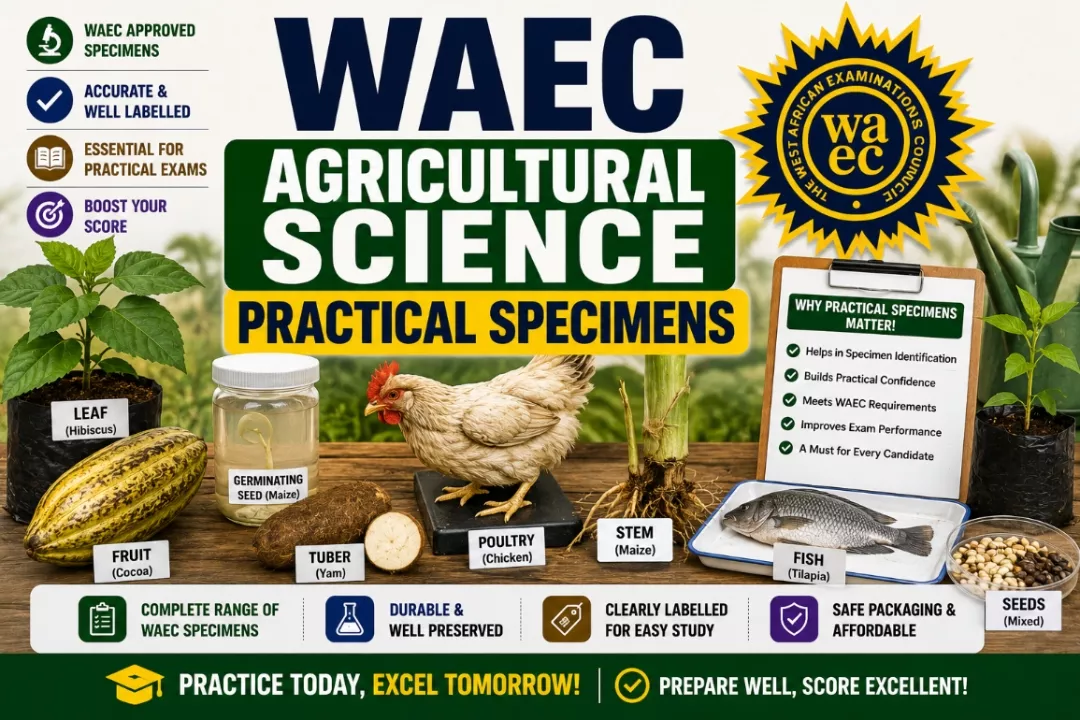
The West African Examinations Council (WAEC) has officially released the WAEC Agricultural Science Practical Specimens 2026 for the West African Senior School Certificate Examination (WASSCE).
Candidates preparing for the Agricultural Science Practical examination are advised to study all the specimens thoroughly and understand their identification features, uses, economic importance, classification, and agricultural functions.
The practical examination is designed to test candidates’ knowledge of farm tools, livestock feeds, organic manure, forage crops, cash crops, and soil improvement materials.
Below is the complete list of WAEC Agricultural Science Practical Specimens 2026 as released by WAEC.
WAEC Agricultural Science Practical Specimens 2026
The following specimens will be provided during the Agricultural Science Practical Examination:
- Specimen A: Poultry Droppings
- Specimen B: Cow Dung
- Specimen C: Water (Labelled)
- Specimen D: Limestone (Labelled)
- Specimen E: Dibber
- Specimen F: Hoe
- Specimen G: Weighing Scale
- Specimen H: Watering Can
- Specimen J: Pineapple (Whole Fruit)
- Specimen K: Cassava Tuber
- Specimen L: Cotton Lint With Seeds
- Specimen M: Groundnut Cake
- Specimen N: Fish Meal
- Specimen O: Elephant Grass
- Specimen P: Guinea Grass
WAEC Agric Practical Specimens 2026 Table
| Specimen | Description |
|---|---|
| A | Poultry Droppings |
| B | Cow Dung |
| C | Water (Labelled) |
| D | Limestone (Labelled) |
| E | Dibber |
| F | Hoe |
| G | Weighing Scale |
| H | Watering Can |
| J | Pineapple (Whole Fruit) |
| K | Cassava Tuber |
| L | Cotton Lint With Seeds |
| M | Groundnut Cake |
| N | Fish Meal |
| O | Elephant Grass |
| P | Guinea Grass |
Candidates are encouraged to familiarize themselves with each specimen, their characteristics, uses, and importance in Agricultural Science, as questions will likely be drawn directly from these specimens during the practical examination.
Detailed Explanation of WAEC Agric Practical Specimens 2026
Specimen A – Poultry Droppings
Poultry droppings are organic manure obtained from poultry birds such as chickens, turkeys, ducks, and guinea fowls.
Uses:
- Improves soil fertility
- Supplies nutrients to crops
- Improves soil structure
- Increases crop yield
Advantages:
- Rich in nitrogen
- Improves microbial activity in soil
- Environmentally friendly
Specimen B – Cow Dung
Cow dung is organic manure obtained from cattle.
Uses:
- Used as organic fertilizer
- Improves soil texture
- Used in biogas production
- Enhances soil fertility
Characteristics:
- Dark brown in colour
- Contains decomposed plant materials
- Rich in organic matter
Specimen C – Water
Water is one of the most important resources in agriculture.
Uses in Agriculture:
- Irrigation of crops
- Livestock production
- Mixing agrochemicals
- Cleaning farm tools and equipment
- Processing agricultural products
Specimen D – Limestone
Limestone is a soil amendment material used to reduce soil acidity.
Functions:
- Neutralizes acidic soils
- Supplies calcium to plants
- Improves soil fertility
- Enhances nutrient availability
Specimen E – Dibber
A dibber is a simple farm tool used for making holes in the soil before planting seeds or seedlings.
Uses:
- Planting seeds
- Transplanting seedlings
- Making holes for young plants
Specimen F – Hoe
The hoe is one of the most common farm tools used by farmers.
Uses:
- Weeding
- Ridging
- Making seed beds
- Harvesting root crops
- Loosening soil
Specimen G – Weighing Scale
A weighing scale is used for measuring the weight of farm produce, feeds, and animals.
Uses:
- Weighing livestock feed
- Measuring harvested crops
- Determining market value of produce
- Livestock management
Specimen H – Watering Can
A watering can is a farm tool used for supplying water to crops and seedlings.
Uses:
- Watering nursery crops
- Applying liquid fertilizers
- Irrigating vegetable gardens
- Maintaining moisture around seedlings
Specimen J – Pineapple (Whole Fruit)
Pineapple is a tropical fruit crop cultivated for human consumption.
Economic Importance:
- Consumed as fresh fruit
- Used for juice production
- Source of vitamins and minerals
- Generates income for farmers
Specimen K – Cassava Tuber
Cassava is one of the most important root crops grown in Nigeria.
Uses:
- Garri production
- Fufu production
- Starch production
- Livestock feed production
Economic Importance:
- Source of income
- Industrial raw material
- Food security crop
Specimen L – Cotton Lint with Seeds
Cotton is an important cash crop cultivated for its fibre.
Uses:
- Textile production
- Manufacture of clothing materials
- Oil extraction from seeds
- Animal feed production
Specimen M – Groundnut Cake
Groundnut cake is the residue obtained after extracting oil from groundnuts.
Uses:
- Livestock feed
- Protein supplement
- Poultry feed ingredient
Nutrients Present:
- Protein
- Fat
- Minerals
Specimen N – Fish Meal
Fish meal is a processed feed ingredient obtained from fish.
Uses:
- Poultry feed production
- Fish feed production
- Livestock feed formulation
Importance:
- Rich source of protein
- Promotes animal growth
- Improves feed quality
Specimen O – Elephant Grass
Elephant grass is a tall perennial forage grass commonly fed to livestock.
Characteristics:
- Fast-growing
- Tall stems
- Broad leaves
Uses:
- Livestock feed
- Silage production
- Soil conservation
Specimen P – Guinea Grass
Guinea grass is a nutritious forage grass widely used for feeding livestock.
Uses:
- Grazing livestock
- Hay production
- Pasture establishment
Characteristics:
- Soft leaves
- High nutritional value
- Perennial growth habit
Likely WAEC Agricultural Science Practical Questions 2026
- Identify Specimens A and B.
- State four differences between Specimens A and B.
- Mention four uses of Specimen F.
- State three functions of Specimen H.
- Classify Specimen J and state its economic importance.
- State four uses of Specimen K.
- Differentiate between Specimens O and P.
- Mention three uses each of Specimens M and N.
- State four agricultural uses of Specimen C.
- Explain the importance of Specimen D in crop production.
- State two similarities between Specimens O and P.
- Describe the functions of Specimen G on a farm.
- Mention three products obtained from Specimen L.
- State three nutrients present in Specimen N.
- Explain why Specimens A and B are regarded as organic manure.
Areas of Concentration for WAEC Agricultural Science Practical 2026
Based on the official WAEC Agricultural Science Practical specimens for 2026, candidates are advised to focus on the following areas while preparing for the examination:
1. Farm Tools and Equipment
Candidates should study the identification, uses, maintenance, and advantages of the following farm tools:
- Dibber
- Hoe
- Watering Can
- Weighing Scale
Questions may require candidates to identify tools, state their functions, and explain how they are maintained.
2. Organic Manure
Candidates should understand the characteristics, uses, and benefits of:
- Poultry Droppings
- Cow Dung
Areas to study include:
- Sources of organic manure
- Advantages of organic manure
- Methods of application
- Differences between poultry droppings and cow dung
3. Livestock Feed Ingredients
Special attention should be given to:
- Groundnut Cake
- Fish Meal
Candidates should know:
- Nutritional values
- Sources
- Uses in animal production
- Differences between plant and animal protein feeds
4. Forage Crops and Pasture Management
Study the characteristics and agricultural importance of:
- Elephant Grass
- Guinea Grass
Focus on:
- Methods of propagation
- Uses as livestock feed
- Differences and similarities
- Pasture management practices
5. Cash Crops and Food Crops
Candidates should study:
- Pineapple
- Cassava
- Cotton
Important areas include:
- Classification
- Economic importance
- Uses
- Products obtained from the crops
6. Soil Improvement Materials
Particular attention should be given to limestone and its role in agriculture.
Study:
- Soil acidity
- Liming materials
- Functions of limestone
- Benefits of liming acidic soils
7. Water and Agricultural Production
Water is an important agricultural resource.
Candidates should understand:
- Uses of water in agriculture
- Irrigation practices
- Water requirements of crops
- Water management on farms
Differences Between Important WAEC Agric Practical Specimens 2026
Differences Between Poultry Droppings and Cow Dung
| Poultry Droppings | Cow Dung |
|---|---|
| Obtained from poultry birds | Obtained from cattle |
| Higher nitrogen content | Lower nitrogen content |
| Decomposes faster | Decomposes more slowly |
| Usually dry in nature | Usually moist in nature |
| Acts faster in improving soil fertility | Acts gradually in improving soil fertility |
Differences Between Elephant Grass and Guinea Grass
| Elephant Grass | Guinea Grass |
|---|---|
| Taller plant | Shorter plant |
| Broad leaves | Narrower leaves |
| Coarse stems | Softer stems |
| Mainly used for cut-and-carry feeding | Suitable for grazing |
| Produces very high biomass | Produces moderate biomass |
Differences Between Groundnut Cake and Fish Meal
| Groundnut Cake | Fish Meal |
|---|---|
| Obtained from groundnut | Obtained from fish |
| Plant protein source | Animal protein source |
| Lower protein content | Higher protein content |
| Contains more fibre | Contains less fibre |
| Usually cheaper | Usually more expensive |
Candidates should study these differences carefully because WAEC frequently asks comparison questions during Agricultural Science practical examinations.
How To Pass WAEC Agricultural Science Practical 2026
The WAEC Agricultural Science Practical examination is one of the easiest papers to score high marks in if candidates prepare adequately before the examination date. Since WAEC has already released the practical specimens, candidates have an advantage because they know the likely areas where questions will come from.
Below are some important tips that can help candidates perform excellently in the 2026 WAEC Agricultural Science Practical Examination.
1. Study All the Specimens Thoroughly
Ensure that you can identify all the specimens provided by WAEC. Learn their names, characteristics, functions, uses, economic importance, and classification.
2. Learn the Uses of Farm Tools
Questions are often asked on farm tools such as the hoe, watering can, dibber, and weighing scale. Candidates should know at least four uses of each tool and how they are maintained.
3. Understand Organic Manure
Pay close attention to poultry droppings and cow dung. Learn their sources, advantages, methods of application, and differences.
4. Revise Livestock Feed Ingredients
Groundnut cake and fish meal are common feed ingredients. Candidates should know their nutritional value, sources, and uses in animal production.
5. Study Forage Crops Carefully
Elephant grass and guinea grass are important pasture crops. Learn their characteristics, similarities, differences, and importance in livestock production.
6. Understand Crop Classification
Be able to classify crops such as pineapple, cassava, and cotton according to their agricultural uses.
7. Practice Past Practical Questions
Solving previous WAEC Agricultural Science Practical questions will help you become familiar with the examination format and improve your confidence.
8. Learn Agricultural Terms
Understand common agricultural terms and concepts related to crop production, livestock production, farm management, and soil science.
9. Read Instructions Carefully
Before answering any question, carefully read and understand the instructions provided by the examiner.
10. Manage Your Time Effectively
Allocate enough time to each question and avoid spending too much time on a single question.
With adequate preparation and proper revision of the specimens, candidates can score excellent grades in the Agricultural Science Practical examination.
Common Mistakes Candidates Make in WAEC Agric Practical
Every year, many candidates lose valuable marks because of avoidable mistakes during the practical examination. Understanding these mistakes can help you avoid them and improve your overall performance.
1. Incorrect Identification of Specimens
Some candidates fail to identify specimens correctly. Always study the appearance and characteristics of each specimen before the examination.
2. Incomplete Answers
Many candidates provide only one or two points when the question requires four or more points.
3. Mixing Up Uses and Functions
Candidates sometimes confuse the uses of farm tools and agricultural materials. Ensure you know the correct functions of each specimen.
4. Poor Spelling of Agricultural Terms
Incorrect spelling of specimen names and agricultural terms may affect the clarity of your answers.
5. Failure to Compare Specimens Properly
Questions involving differences and similarities require clear comparison points. Avoid vague answers.
6. Lack of Adequate Preparation
Waiting until the last minute to study practical specimens often leads to poor performance.
7. Providing Irrelevant Answers
Always answer questions according to what is asked. Do not write unnecessary information.
8. Poor Time Management
Some candidates spend too much time on a particular question and fail to complete the paper.
9. Failure to Revise Practical Notes
Practical notes contain important information that can help candidates answer specimen-based questions correctly.
10. Ignoring WAEC Specimen Lists
The official specimen list provides valuable guidance on what candidates should expect during the examination. Ignoring it can put a candidate at a disadvantage.
Avoiding these common mistakes can significantly improve your chances of scoring high marks in the WAEC Agricultural Science Practical Examination 2026.
RELATED POST
WAEC Biology Practical Specimens 2026
WAEC 2026 Chemistry Practical Specimens (Alternative A)
WAEC Livestock Farming Specimen 2026
Conclusion
The WAEC Agricultural Science Practical Specimens 2026 provide candidates with an excellent opportunity to prepare effectively ahead of the examination. Since the specimen list has already been released, students should take advantage of this early information by studying each specimen carefully and understanding its characteristics, uses, economic importance, and agricultural functions.
Candidates are strongly advised to focus on important areas such as farm tools and equipment, organic manure, forage crops, livestock feed ingredients, soil improvement materials, and cash crops. These topics are frequently tested during the Agricultural Science Practical examination and often form the basis of specimen-based questions.
In addition, candidates should practice answering past practical questions, learn how to identify specimens correctly, and master comparison questions involving similarities and differences between specimens. Consistent revision and proper preparation will significantly increase your chances of obtaining an excellent grade in the examination.
Remember that success in WAEC Agricultural Science Practical is not only about memorizing answers but also about understanding the practical applications of agricultural concepts and materials.
Bookmark this page and check back regularly for WAEC Agricultural Science Practical Questions and Answers 2026, specimen explanations, and examination updates.
Also, don’t forget to share this guide with your classmates and friends preparing for the 2026 WAEC Agricultural Science Examination.

Zamgist Education Desk is the editorial team behind Zamgist, providing reliable and practical updates on JAMB, WAEC, NECO, admissions, scholarships, recruitment and other education-related opportunities in Nigeria. Our content is researched from official and reliable sources and updated when important information changes.