 Zamgist
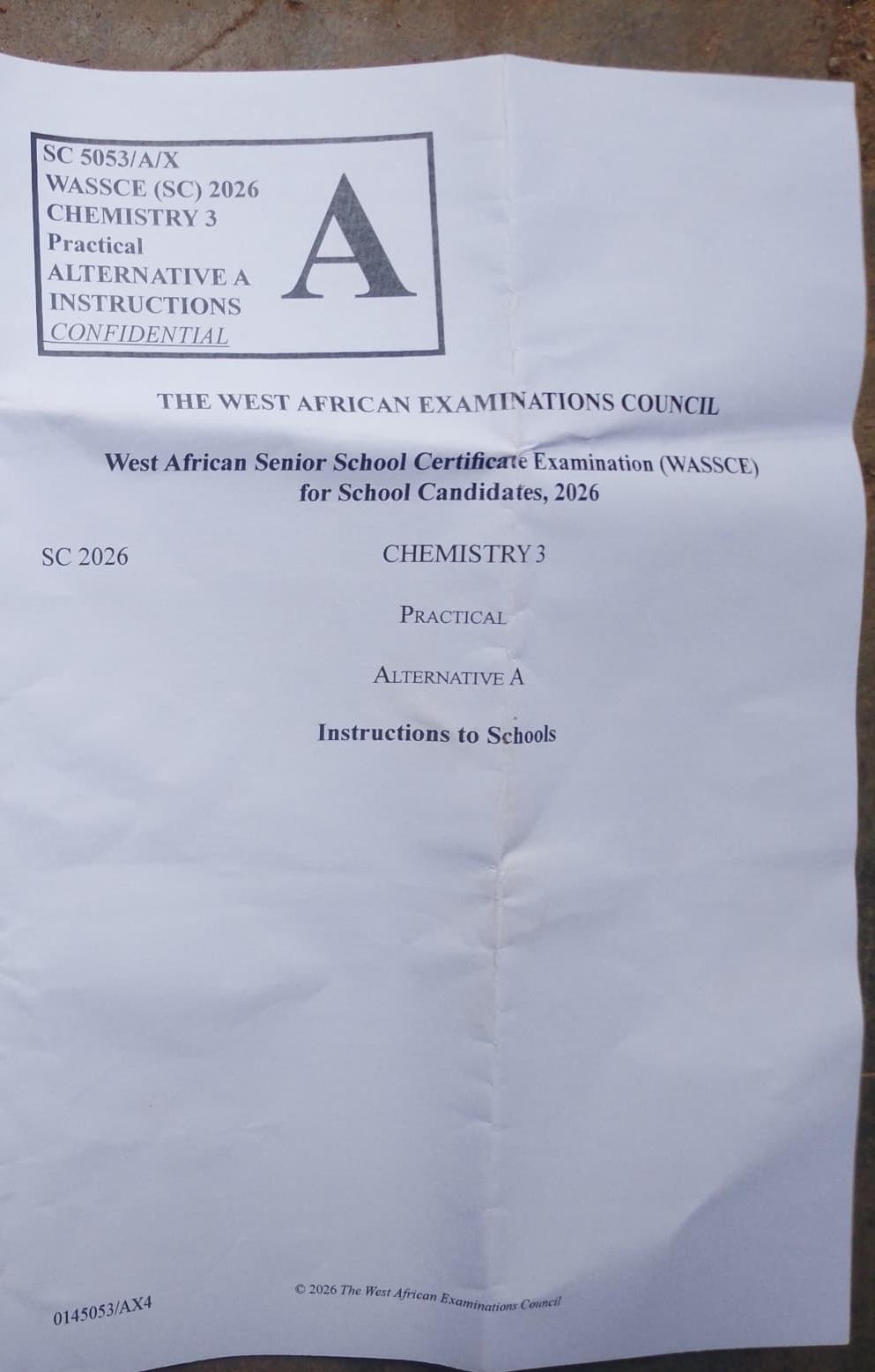
Are you preparing for the 2026 West African Senior School Certificate Examination (WASSCE)? If you are a science student, the Chemistry practical is one of the most critical papers you will face. To help you prepare adequately and secure an A1, Zamgist has compiled the official WAEC Chemistry Practical Specimen 2026 (Alternative A) instructions, apparatus, reagents, and likely questions.
Quick Summary
- Exam: WASSCE 2026 Chemistry 3 Practical (Alternative A)
- Quantitative Analysis (Titration): Involves an acid solution labelled ‘An’ (H2SO4) and a base solution labelled ‘Bn’ (NaOH).
- Qualitative Analysis: Involves a solid mixture labelled ‘Cn’ (a 1:1 uniform mixture of lead (II) carbonate and starch).
- Quick Tip: Candidates must be highly familiar with acid-base titrations and the specific tests for starch (using iodine) and carbonate/lead ions.
Official WAEC 2026 Chemistry Practical Specimens & Solutions
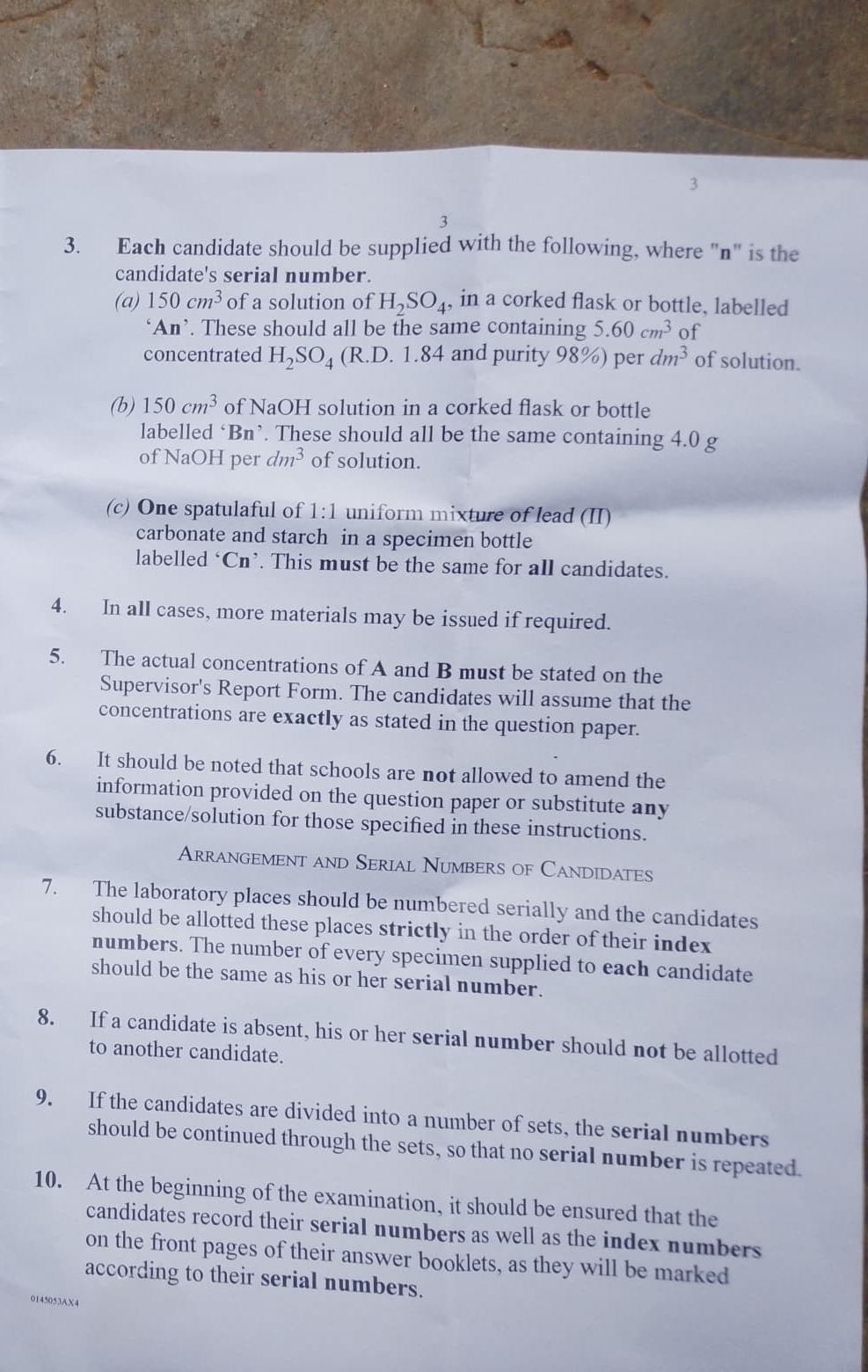
Every candidate sitting for the Alternative A Chemistry practical will be provided with specific solutions and solid mixtures. Based on the confidential 2026 instructions sent to schools, here are the core specimens every candidate will receive:
| Label | Specimen / Solution Description | Purpose |
|---|---|---|
| An | 150 cm³ of H2SO4 solution (contains 5.60 cm³ of conc. H2SO4 per dm³) | Titration (Acid) |
| Bn | 150 cm³ of NaOH solution (contains 4.0 g of NaOH per dm³) | Titration (Base) |
| Cn | One spatulaful of a 1:1 uniform mixture of lead (II) carbonate and starch | Qualitative Analysis |
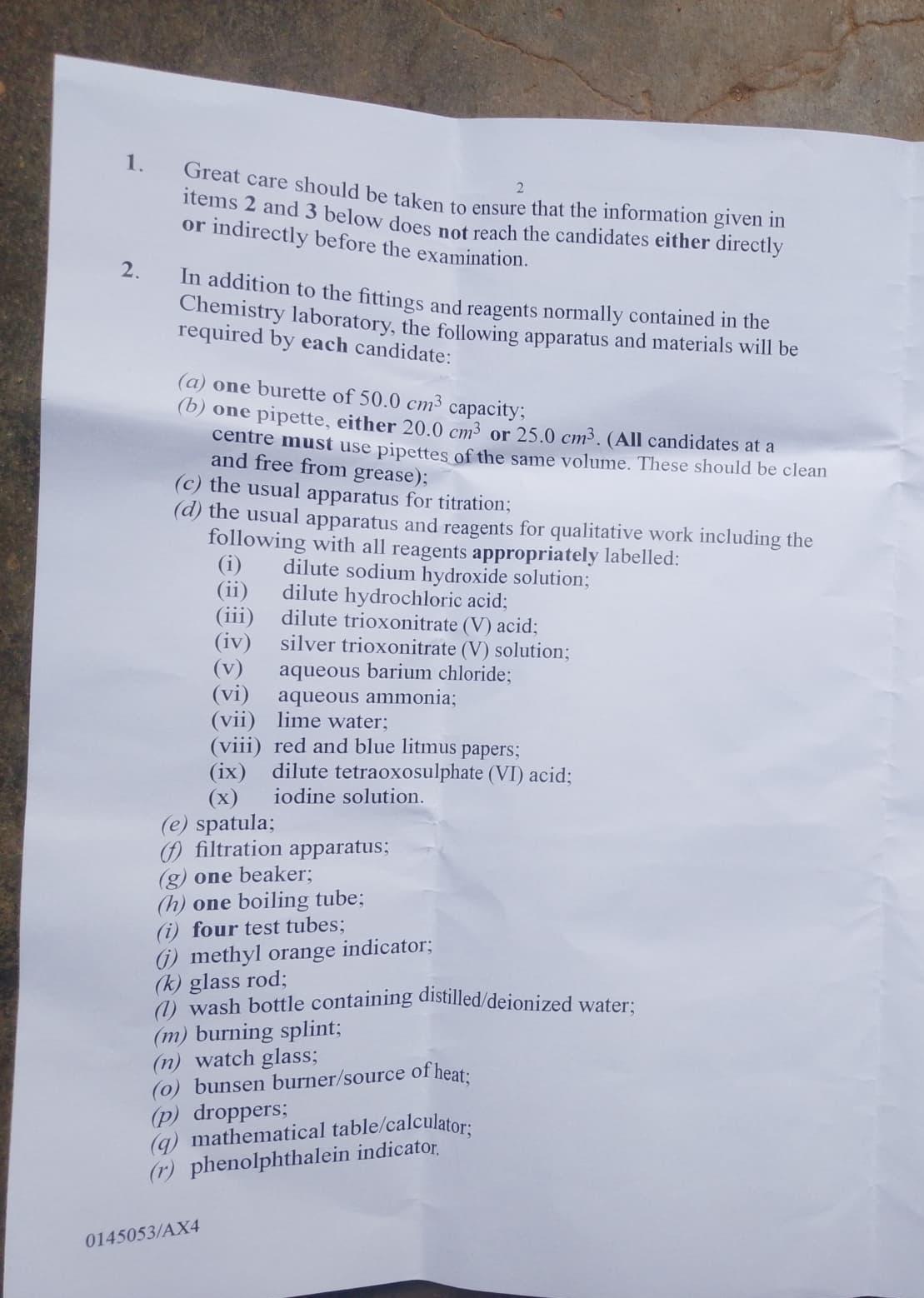
Complete List of Apparatus and Reagents
In addition to the specific specimens above, your school’s laboratory must provide the following standard apparatus and reagents for each candidate:
General Titration & Qualitative Apparatus
- One burette (50.0 cm³ capacity)
- One pipette, either 20.0 cm³ or 25.0 cm³ (All candidates at a centre must use pipettes of the same volume)
- Filtration apparatus
- One Beaker and One Boiling tube
- Four test tubes
- Glass rod, Spatula, Watch glass, and Droppers
- Wash bottle containing distilled/deionized water
- Bunsen burner / source of heat and a Burning splint
- Mathematical table / calculator
Standard Test Reagents Required
- Indicators: Methyl orange, Phenolphthalein, Red and Blue litmus papers.
- Acids: Dilute Hydrochloric acid (HCl), Dilute Trioxonitrate(V) acid (HNO3), Dilute Tetraoxosulphate(VI) acid (H2SO4).
- Bases: Dilute Sodium hydroxide solution (NaOH), Aqueous ammonia (NH3).
- Specific Test Solutions: Silver trioxonitrate(V) solution (AgNO3), Aqueous barium chloride (BaCl2), Lime water, Iodine solution.
Detailed Breakdown & Likely Questions for 2026
Knowing the specimens is only half the battle. Here is exactly what you will be asked to do with them during the exam.
Question 1: Quantitative Analysis (Volumetric Titration)
The Reaction: Candidates will titrate the acid ‘An’ (Tetraoxosulphate(VI) acid – H2SO4) against the base ‘Bn’ (Sodium hydroxide – NaOH). This is a standard strong acid versus strong base titration.
Likely Calculations: You will be required to record your burette readings in a table and calculate the average volume of acid used (titre value). Expect follow-up questions asking you to calculate:
- The concentration of the acid and base in mol/dm³.
- The mass concentration in g/dm³.
Key Tip: Ensure your titration figures are recorded to at least one or two decimal places (e.g., 22.50 cm³) and that your readings are consistent to avoid heavy penalization.
Question 2: Qualitative Analysis (Salt Testing)
The Specimen (‘Cn’): This is a mixture of Lead (II) Carbonate (PbCO3) and Starch. You will be required to carry out tests to identify the ions and compounds present.
- Testing for Starch: The presence of Iodine solution in the reagent list is a dead giveaway for a starch test. When you add a few drops of iodine to the filtrate or mixture, it will turn blue-black, confirming the presence of starch.
- Testing for Carbonate (CO32-): Adding a dilute acid (like HCl or HNO3) to the solid mixture will cause effervescence (fizzing). A colorless, odorless gas will be evolved which turns lime water milky. This confirms the gas is CO2 and a carbonate ion is present.
- Testing for Lead (Pb2+): When you add NaOH in drops and then in excess to the solution, a white precipitate will form that dissolves in excess NaOH. Adding aqueous ammonia (NH3) will form a white precipitate that is insoluble in excess.
WAEC Chemistry Practical Rules and Safety Precautions
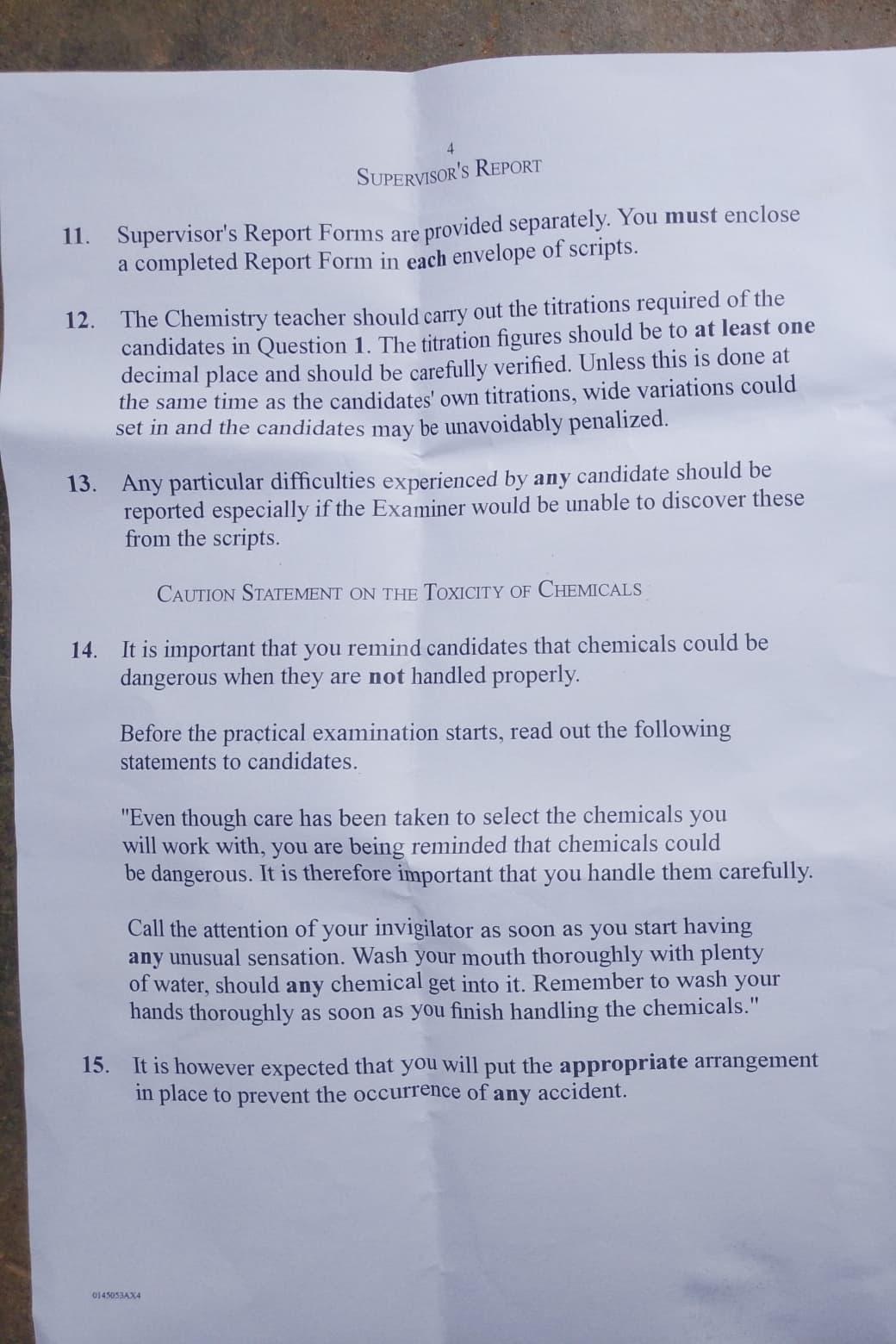
- Safety First: Chemicals can be dangerous. If any chemical gets into your mouth or spills on your skin, wash it immediately with plenty of water.
- Do not forge data: Your Chemistry teacher will carry out the exact same titration and submit a Supervisor’s Report Form with their values. If your results deviate too widely from the supervisor’s results, WAEC examiners will assume you forged your data and you will lose marks.
- Record immediately: Write down your observations and inferences in your answer booklet as you perform the tests. Do not wait until the end of the exam to guess what happened.
Stay Updated with Zamgist!
Do you want to get more WAEC 2026 practical updates, questions, and verified answers? Join the Zamgist community today. Good luck with your exams!
RELATED POST
WAEC Livestock Farming Specimen 2026
How To Get WAEC Answer Before Exam (Midnight)
WAEC Yoruba 2026 Questions And Answers
WAEC Igbo 2026 Questions And Answers
WAEC Hausa 2026 Questions And Answers
FAQ
Specimen ‘An’ is a dilute solution of Tetraoxosulphate(VI) acid (H2SO4), while ‘Bn’ is a standardized solution of Sodium hydroxide (NaOH). Both are used for the quantitative titration experiment.
Specimen ‘Cn’ is a 1:1 uniform solid mixture of lead (II) carbonate and starch. It is provided for the qualitative analysis (salt testing) part of the practical exam.
Because the experiment involves a strong acid (H2SO4) and a strong base (NaOH), either methyl orange or phenolphthalein can be used. However, you must strictly use the specific indicator stated in your question paper on the day of the exam.

 Zamgist